Saturday, March 30, 2013

Nexus 600 Adventure Cat

My good friend Alan Harrington from HBYC recently launched his new boat, the Nexus 600. Now Al and I have had a good few beers together over the past few years, and certainly I had heard quite a bit about this boat before seeing it, but nothing could have prepared me for the surprise on the day I first saw it - about two weeks ago....

I will have to be careful not to over-write this boat! It simply is about the nicest thing I have seen or contemplated as boats go. Its huge, beautiful, oozes quality, and it sails quite beautifully. Its nicer than a nice boat, and its nicer than a nice house..... Her name is "Ke Nako" - a Sesotho expression for "Now is the time". 

As interesting as the boat itself, is the way it came about, and the people involved. Al - the owner, is a newly retired very successful businessman, with a passion for boats, cars, technology and Windhoek Lager. This is not his first boat build either. He was involved in every little detail from the outset, and has given huge input to the way this all played out. In fact many people have added to the story - the Nexus crowd are very open to all and any good ideas. Find them at www.nexuscatamarans.com.

The Paarman brothers (the surfing bunch) and team, are the originators of Nexus cats and the concept behind them. I think it was Mark Paarman who originally conceived the need for a large load-carrying cat for surfing charters etc. There simply wasn't anything available in this size and shape. Somehow Jonathan (pro boat builder) and Roger (MD and factory manager) were brought into the mix, and they setup shop in St Francis to make the first cat. John Henrick too. The designer was Anthony Key. Subsequently others have also become involved - a guy called Phil Berman, and du Toit naval architects. Its a project that has hit a sweet spot, and suddenly everyone knows this is a very useful platform.....the fourth one is now taking shape in the factory.

By nature, cats of this size and price are "low volume" production items. This means you get to work closely with the builders, and a fair bit of customisation is possible. And you couldn't find a nicer bunch to work with than the Paarmans - nice down to earth people. On the day I went sailing on this thing Roger was aboard, in fact he was living on board at Al's invitation, and clearly the relationships between client and builders was excellent, more like an extended family by then. Ditto for the others involved. If you want to build a boat, this is a critical element of it. If it was me, I would chose good builders first, after that the rest comes easy....not to mention the boats "karma"!

About a third of the world's cruising cats are built in South Africa, and certainly many of them have excellent reputations. We have great designers, great sailors and some excellent builders. Think Robertson and Caine and Southern Wind. But Nexus is right up there with them and they produce an excellent quality vessel....maybe the best to come out of SA, maybe the best of its kind anywhere?

The aft decks are huge, really well appointed and designed. In warm climes, this is really where you live. Think about the space on a 44 cruising cat and multiply by about six..... a lovely RIB tender hangs off the back, with dive compressor and a 20 KVA genset lurk under sound-proof hatches in the deck.
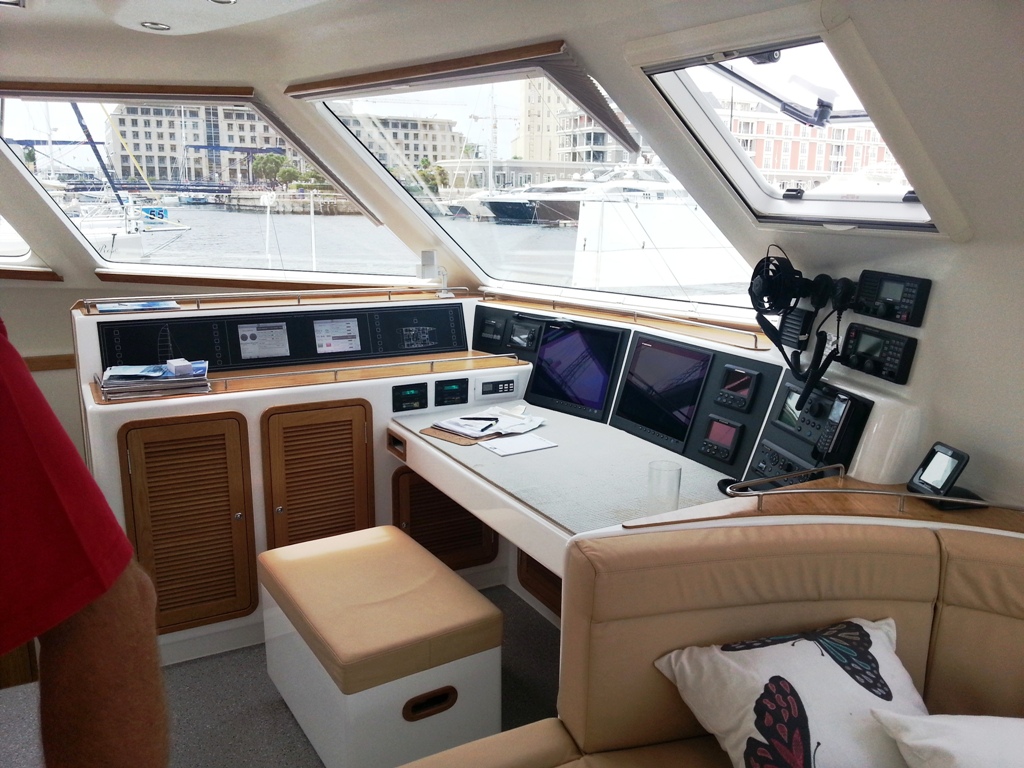
The bridge. This an uber-cool station with every lovely marine instrument you can imagine accessible through some Furuno multi-function screens. Great radio kit (ICOM M603 and M801E) plus a satphone. Most of it replicated on the helm position, and performance indicators in each of the four cabins, and above the aft-decks..... I like this place.....

The electrics on this boat are not trivial.... Power comes from either shore power, a 19 KVA Cummins-onan genset (unbelievably quiet), or a large battery bank with a 10 KVA inverter. Besides the instrumentation and lighting, you will find about 8 fridges or freezers, a few microwave ovens, TVs and music, a large watermaker, dive compressor, four large airconditioners, and a plethora of electric winches, windlasses etc. To bring this altogether, Alan took the plunge and installed a fantastic switching system made by Mastervolt. It saves loads of cabling, and allows amazing flexibility in configuration. Home automation on steroids. Al explains it best here.


The indoor saloon. Fine leather, great views!
 The galley. Like a nice house. Great views. It stays level! See the capuccino machine on the far side.
Home entertainment. Great systems with Bose speakers reaching every corner.


 View from the foredeck. That's Table Mountain slipping behind the stern...
 The helming position. from the other side. Sorry I didn't get this one close-up. Its comfortable and dead-easy to do it all from here. This boat can be steered, tacked and all things done easily by one person from the helm station. Electric winches help, but it really is a triumph of well organised sheets, winches and jammers. 
How does she sail, do I hear you say? Well, on the day I went out, we had 10-14 kts at  times, and a nice flat sea. We saw 7-10 knots mostly under main and genny only. 8 knots under power (slow cruising speed in first gear), with a fair reserve, she could run at 10+ under power if necessary. The following week, Al went out and found a patch with 20-30 knotsof wind. They saw 20 knots on the log.... I suspect that on a passage, using spinny and code-0, she could average 10-20 for extended periods. With no fuss at all. People below decks would not even know, except for the instruments! She seemed to tack through 100 degrees though I have to say we weren't even trying. And then there's 2 x 110 Hp Yanmars to use if you really want to press on.

Tacking the boat is dead easy. She shows no inclination to stall in the turn at all - you can take it easy and just rely on the momentum and her deepish keels to take her round. Mainsail looks after herself as one would expect, and the jib comes around easily by hand, amazingly. Then you add tension with the size 60 motorised winches.... one person can do this all quite easily from the helm station. Even the furler on the genny is electric, and single touch on that button can be used to angle the headsail foil optimally for the tack. Despite the monumental size of the sails, its astonishingly easy.....

See her vital-statistics here....

Overall, I loved this boat because she really is conceived by sailors and boats-people with nautical recreation in mind. Not by interior decorators and bling artists. She is very well thought out and well appointed, but no bling. For instance the ceilings are clean white stipple paint, but table surfaces are a nice bamboo finish. The spaces for the engines, the genset, the lazarettes, the chain stowage, the diving compressors etc etc etc are large, clean and open. No space for creepies and dirt that scares the hell out of one when looking at used boats! The sailing kit is all top notch and really looks the business. The sails are not for show. Sailing, reefing, furling and anchoring is all functional and top notch.


 I haven't even mentioned the cabins below. They are spacious, practical and the beds are extremely comfortable. Each cabin has a 16k BTU aircon. Al has sacrificed one set of heads for a laundrette with a Miele washing machine and tumble-dryer.

Overall, this is one boat you can live on with all home comforts and then some. I couldn't think of a nicer place to be. Plus she sails really well, and has the quality you expect for an investment of this nature. For chartering and excursions, I can't imagine better. 

Is there anything to criticise on this boat? Well not that I know of. I can't tell if she slams in a seaway because I haven't been there. The bridgedeck is higher than most. For her intended purpose, I can see no problems at all. Cold climes and/or the Southern Ocean may be different,  and certainly she is no river cruiser given her beam of 8.7m, and a mast that rises about 26m above the water! Draft though is a very acceptable 1.4m.

What does she cost? About the same as the latest Ferrari..... I know which I would rather have!


UPDATE: Nexus Cat (Balance 601) as a Passagemaker:


Earlier this week (1-3 October 2013) - I had the opportunity of joining the boat for the delivery trip from St Francis to Cape Town for the annual Cape Town Boat Show. This is a voyage of about 350 n.m. and takes 2-3 days if the weather is favourable. Essentially, this is the "Cape of Good Hope" passage and is one of the three "Great Capes" in the mind of seafarers - along with Cape Horn and Cape Leeuwin (S Australia). One needs a favourable weather window, a very sound boat, good sea-legs and a touch of madness for his trip. Very few bolt-holes en route. 

As it happened, the weather forecasts were very favourable for the period and then some. The boat I knew to be exceptionally capable, and luckily I had some free time. Plus my mate Nick was also available to join, and a day later we were on a small plane bound for Port Elizabeth, where Al collected us. After a pleasant meal with the Paarman-Harrington-Nexus ensemble at St Francis that evening, we slept aboard - very comfortably I might add. Next morning we did a quick tour of the Nexus factory - a neat and well run operation, where we were proudly shown the bare bones of Vessel-4 under construction. Impressive stuff - but I don't have space to cover this here.

By 10 a.m. the wind was quite fresh - about 25 knots - and the sea was already looking quite distressed - with a large chop across the swell and plenty of white caps. The sort of day that ski-boats stay in harbour, and commercial trawlers curse. Although the conditions were very much stronger than the forecast we did have a following wind, and of course the boat is large and dry. So off we went  - the four of us - skipper Matt, Al, myself and Nick.

We exited the harbour straight into the fresh wild chop in the bay. Cats do a remarkable job of cleaving their way through a big chop whilst keeping you dry and comfortable - especially 60' cats that weight 25T. We pushed along to Seal Point under motor before heading West, when we cut the motors and released the genoa. By now we had a North Easter pushing 30 knots on the stern quarter and so we took off at a decent 10-12 knots down the coast on jib alone. It made for a comfortable ride as the rather big following seas swept slowly past. Very pleasant for an hour or two. We had a pleasant lunch and sat on the aft deck admiring the view and the waves, plus the odd whale.
Al is monitoring a fishing boat.
Conditions were quite wild outside.

The seas continued to build, and the wind strengthened to about 35 knots. Al loaded a new set of Grib files via the sat-phone - they still reported about 9-12 knots of wind and low swell conditions! Cape Town Radio seemed to concur. Conditions to the East of us were reported quite strong however, whilst the weather to the west was reported to be far better. It seemed the weather system of the east had come quite a bit further West than anticipated....

By sunset, the seas were actually quite large, with steep waves of 2-3 m powered along with 35 knots of wind. Quite a lot of white water blowing off the tops, and the odd foamy trying to climb on the back. Even the passing ships were bouncing around. The big cat would rise on each following wave and surf down to the back of the next one, then slow down as a large green wall chased up behind us again. And so this went on until midnight as we trundled on at 8-12 knots, with a few faster surfs. I recall thinking how unbelievably horrible these conditions would be in a lesser boat...even a 45' monohull...

For some reason I didn't manage all my supper that evening, and put my head down at about 10 p.m. - in my large double cabin. And then the world went quiet and all was well - I slept soundly until morning. The big cat drove herself peacefully through the night with Matt and Al keeping watch on the AIS and Radar. At midnight the wind slacked off notably - and on went the Port engine, keeping our speed to eight knots. Al doesn't like anything less than eight knots.

All the while there was very little slamming - just a bit of a water rush between the hulls as waves came through. Nothing unsettling at all. At no stage was there anything scary - the platform is immensely stable - and very rigid. No flexing or groaning at all. Although it isn't fun being in a big sea - full stop - this boat gave no reason for concern. That's not to say I would have fancied going upwind that night, mind you, except for a man overboard situation or similar....

Some cellphone footage on youtube:

  1.  http://youtu.be/752FIy0fMP8
  2.  http://youtu.be/nolXwyqFuL0
  3.  http://youtu.be/7D6lNfVW8fg

By morning the conditions had improved significantly although the sea was still quite confused and lumpy. Despite this we rumbled along at a steady eight knots with the two Yanmar 110s. Slowly the wind swung north and then West and soon it was straight on the nose at 18-20 knots, where it stayed most of the afternoon. We kept going at 7-8 knots boat speed, and a sizeable chop right on the nose. There was the occasional slam and bang, but nothing serious. My afternoon siesta was not disturbed fortunately.

Night-watch is a civilised affair, with excellent nav, 
soft music and espressos....

By nightfall conditions were very very mild - sea was completely flat and amost zero wind. Speed increased to 10 knots as the weather conditions settled - with the Yanmars idling along at 2000 r.p.m. The sky was unbelievably clear and I opted to join the night watch just for the fun of it. This is where I had the chance of experiencing the magnificent facilities at the indoor bridge and the semi-enclosed helm station. Now I am no stranger to the joys of chartplotters etc and decent comms, but in my previous experience (single-handing) this usually means a handheld plotter in one hand, a VHF handheld in the other, mainsheet in my teeth, a tiller-pilot, freezing wind on my face and some cold seawater in my jacket somewhere. Little chance of coffee... Observing and avoiding other vessels becomes a lesser priority mixed in with need to get to the heads or out of the cold... So the idea of sitting at the plush indoor bridge station, with two large nav-screens with radar, chartplotter and AIS overlays, whilst listening to soft music did make a fair impression on me. Did I mention the espresso machine? The ICOM M602 VHF - with its antenna in the clouds, was as clear as a bell. The Cape sea-route is increasingly busy - usually at least 10-12 large ships on the screen at any time - all doing significant speeds. Then there's the little matter of small craft like fishing boats and yachts that often don't show on the AIS and can be hard to sight visually at night. The large radar screen does a great job of finding these, and can track these targets individually showing course, closest approach etc etc. Its all very clear and easy to use. Slight adjustments to the auto-pilot are easy to make from below (or above), and the AIS will immediately reflect the revised closest point of approach. In this way other vessels see the same picture - and much chit-chat is eliminated. What a pleasure...plus all the boats systems are accessible and controllable from this position - example battery states, water levels, nav lights and so on. 
Morning coffee as we passed Llandudno.

Cape point loomed up at 05:30 next morning, and with a sea like a milkpond we arrived at the V&A Waterfront just 3.h hours later! 3.5 hours from Cape Point to the harbour! 

So that's what the Nexus 60 (Balance 601) feels like as a passagemaker.....that was 350 n.m. in a real mix of weather, covered in 46 hours, that's about 180 n.m. per day, which I think is a realistic number for a long-term cruising average in mixed conditions.  Certainly one could push much harder, and with mainsail and decent conditions one could see daily runs of around 300 n.m. quite comfortably. My little bottle of vitamin pills sat calmly on the smooth bamboo galley counter for all of this, never moved once...

Ke Nako has now done a few months cruising the Mocambique cost around Pemba Bay and vicinity, and has done some honest service as a fishing and diving platform, seaside hotel and passagemaker. Besides some minor problems with the greywater pump, she has had no problems at all. Shee is still in boatshow condition - see her at the Cape Town Boat Show this weekend (4-6 October 2013). 


Tuesday, July 3, 2012

Farr 38/40

No discussion of a Farr boat can avoid some discussion on Bruce Farr (O.B.E.) himself. Certainly I am out of my depth, and at a loss for words, when it comes to discussing this great man, clearly one of the most successful designers of performance yachts ever.

Born in Auckland in 1949, Bruce was an accomplished and keen Dinghy sailor. By his late teens he was designing and building very fast dinghies. By his early 20s he had a number of fast and light keelboats to his name. The Farr 38/40 reviewed here was drawn in 1978 - Bruce will have been 29 years of age.

A quick glance at the design list on www.farrdesign.com left me in a slight state of shock. There are literally hundreds of designs (I didn't have time to count them all) - but so many big name boats I hadn't known were his. For example Ceramco (early Whitbread maxi), the new Farr 40s, Transpac 52s, Mumm 36s, some of the super Maxis eg Mirabella and the big Wallys, many of the lead Volvo 70s, half a doxen Open 60s and Whitbread 60s - it goes on and on and on). Did I mention the America's Cup yacht KZ-1, many of the recent Bavarias and Beneteaus? Anyway, the Farr 38/40 sits right in the middle of the list as a small "performance cruiser" if you don't mind! I had a good chuckle when I read the brochure, describing this as unashamedly a cruiser! 
See http://www.farrdesign.com/pdfs/172brochure.pdf if you don't believe me! Its an instructive read. Felt like I was laughing in church! Where I come from this is quite a mean machine. They go like hell, are capable of winning anything in our club classes and occasionally even line-honours amongst some large modern thoroughbreds. The local Farr 38/40 "Al" has been well campaigned and just proves the performance credentials of this design. As for a cruiser? - well think of taking the family on holiday in a four-seater Ferrari, instead of the Volvo this year. 
 HBYC's Faraway in fresh conditions off Hout Bay beach.
HBYC's Faraway in light conditions under Chapmans Peak.
Farr 38/40 Sailplan and Layout. Click for fullsize.
As a designer, Farr stands out as someone who really made the case for light boats, and safe, seaworthy, light boats at that. The yachting world was really quite shocked when his designs first appeared - refusing to believe that such relatively light boats could be seaworthy. I wouldn't say he was the first - even van der Stadt was doing this - but nobody popularised the case better than Farr. The other thing Farr seems to excel in is optimising the proprtions and dimensions of a boat for a given race or task. Ceramco (68') was such a yacht - skippered by Sir Peter Blake in the 81/82 RTW Whitbread Race. It weighed about 2/3 that of its main competitor, Flyer-2 76' (S&S, Conny van Rietschoten), yet they sailed almost within sight of each other around the world. But for an unfortunate dismasting on the last leg I think, Ceramco would have clearly won . . .
Farr 38 /40 Hull Profile. Note the bulb keel, deep high aspect spade rudder,
and the 2' sugar scoop on this one.

Back to the Farr 38/40. Unlike many of the others in this blog, Bruce Farr is not a South African designer (we make a very special case for Kiwis though!). However this design has been very popular here, as a very good offshore-racer, club-racer and class-racer. They are seldom campaigned under IRC as the ratings are just too punitive -  as this class was designed in a conscious departure from any rating systems.

You will note this class is often referred to as the Farr 38 (40) class. The original design is for a 38 footer, and the 40s have an extended sugar-scoop stern - presumably for downwind racing. The example I am most familiar with - viz. HBYC's "Faraway" has recorded consistent speeds at around 17 knots for extended periods on the Cape to Rio race - so clearly they can plane well. Notably, this boat was rolled 360 degrees by a large breaking wave near Saldnaha Bay on the return from Rio - it righted promptly, with only a broken vang, and a fair bit of mess down below!

"Faraway" - above - has tiller steering, running backstays, the sugar scoop extension, no lazy-jacks, and generally no roller furling. In my humble opinion, she is dam hard work, and the owner skipper - Chris Sutton, a hardy and wild old 72-year old (also our ever popular Commodore) show no sign of repenting on these matters, as long as he can muster 6-8 crew! This is not a good example for shorthanding, and single-handing is totally unthinkable. In truth - this is not actually what Farr intended. With suitable rigging, she would be dead easy to sail shorthanded, as indeed some are. She also sails beautifully under main alone. I am not sure whether she was originall drawn with a tiller or a wheel - both examples are common here - but certainly the tiller is great, and she sails like a dream. In the rough conditions around Cape Town (not to mention Hout Bay's own horrific squalls), she is safe and quite forgiving, and always fast. In light airs she is also very impressive. This truly is a safe all-weather boat. The cockpit is ample and well suited to a busy racing crew, while also nice for cruising. The open stern and sugar scoop make boarding exceptionall easy. The accommodations are really basic on this example, but in many cases are very comfortable and well fitted below. Not huge for a 38 footer below - but certainly acceptable for a long downwind race.  . . .

This is Hocus-Pocus - also at Hout bay - a very clean example with
wheel steering and a single backstay. This is also predominantly
a racer, so no lazy-kacks and roller furling either.

Clean deck lines on Hocus-Pocus.

Design Specifications
LOA:
DWL:
Beam:
Draft:
Displ:
Ballast:
11.66 m/38'3"
9.50 m/31'2"
3.66 m/12'
1.94 m/6'4"
4800 Kg/10600 Lbs
1850 Kg/4100 Lbs

Farr's own commentary, per their website:
Design #72 Farr 11.6/38
November 1981
The Farr 11.6 metre (38 ft) fast cruising sloop continues to gain popularity around the world. At present there are 85 boats sailing in 8 countries. Designed in 1978, the yacht was inspired by a trend away from the IOR Rule restrictions towards a 'pure' design concept to produce a fast, comfortable, easily handled and relatively economical yacht. Changes to the IOR Rule in 1977 and 78 were obsoleting yachts the year following their launching as well as distorting hull shapes. It was time to look toward the one-design concept that offered security of invenstment and pleasureable sailing.
The Farr 11.6 metre has achieved these aims. It does not rate very favourably under IOR - but it was never intended to. It is simply a very fast cruising boat but will race boat for boat with the best of the 2 tonners. In general terms, the style is for a light (ish) displacement hull form, moderate beam by modern standards with powerful sections, a wide stern and fin bow. The powerful hull coupled with a good percentage of ballast set low in a high aspect keel with fine bow sections makes the boat stiff and ensures excellent performances to windward (particularly in rough water).
This rig is non-masthead swept spreader arrangement with no complicated runners. It has easy to handle headsails and a mainsail large enough to drive the boat by itself for 'nonchalant' cruising. The boat has a high sail area-to-displacement ratio to ensure downwind speed.
The interior design is definitely cruising oriented. It features wide safe companionway steps, 2 or 3 double berths, big galley with fridge and freezer, separate navigation area, separate head and shower. There is an abundance of storage space in the main cabin area and in the wide stern. The boat can cater comfortable for up to 9 people.
Initially the boat was designed for 2 Auckland yachtsmen who previously had owned and competitively sailed one of Bruce Farr's first cruising yachts, and who wanted a fast cruiser/racer to compete in 2nd division Royal New Zealand Yacht Squadron series. The first wooden boat, GOLDEN EAGLE, was launched in January 1979. By that time some 16 wooden boat plans had been sold and production for a one-design class yacht was underway in New Zealand and Australia, the first glass boat being launched in Auckland in August 1979. The Farr 11.6 metre was adopted by the Royal New Zealand Yacht Squadron as a class for one design racing. Hightly competitive racing has developed in New Zealand and Australia with yachtsmen crossing the Tasman to compete in events. Owners Associations formed in both countries control class restrictions and racing.


Wednesday, June 20, 2012

L36, Tosca 36, and Atlantis 36

Angelo Lavranos has a huge portfolio of designs to his credit, covering many different concepts. It is always interesting to look at his designs, because they conform to no particular dogma and are all based on very good thinking and experience. Including mini-racers, super-maxis, medium cruisers, cats, houseboats and powerboats - he has done them all . . .
I have had a few requests to cover the L36, the Atlantis 36 and the Tosca 36. It makes a lot of sense to look at them together - they are three quite different but equally good forms of a medium sized performance cruiser.

The L36  - is the first design of the three - around 1977/8 - and maybe the most successful. This is also possibly the purest design in that she was designed straight from Angelo's pen - no untoward influence during the design process. Angelo owned one personally for about 16 years viz. "Phoebe" now of FBYC. The L36 is a medium/heavy displacement hull, carries a poweful rig, is a strong all-rounder and held some interesting race records - Cruising division in Cape to Uruguay, and Durban - Cape Town under sail. Designed in the late 70s, she was designed as a "little sister" to the Compass 47, with known properties and dynamics. She carries a masthead rig, not so common today, but which I personally prefer to the modern trend of dominant mainsails - especially for cruising. I am not quite sure why the dominant mainsail thing happened - was it IoR or similar, or the attratction of bendy masts, or the S&S doctrine that favoured fractional rigs? Hopefully I can get a designer to explain this soonish.

L36 flying along in Table Bay.
The L36 is quite a perfomance boat, and a great all rounder as a performance cruiser on all points of sail, though I expect her strongest point will be upwind, where her powerful keel and relatively low wetted area will work well. The hull is moderate - not sportsboat, and not heavy long-keel cruiser. The ends are reasonably fine, making a good sea-boat as well, but not exactly a "downwind racer". The longish keel and deep skeg-hung rudder right on the stern, combined with a fairly slender hull, will give her good balance of responsiveness and ability to track and go straight, whilst not having excessive draught. I can't see this design having any vices, and by reputation they do not. Certainly this has been a very successful all rounder, great for cruising and racing. Despite her proven performance, there are no obvious compromises as a cruiser - certainly she would be on my list as a very good blue-water liveabord cruiser for a couple.

Today we can easily describe this design as a very good conventional performance-cruiser. However one must remember this was quite amazing in the late-70s - pure eye-candy I am sure - and is a credit that so many boats still look exactly like this. . . . At least 50 were built, all in GRP as far as I know.


 Moderate longish keel, skeg-hung semi-balanced (spade) rudder. Prop washes straight over the rudder. Moderate beam and reasonably fine ends. Note the fuel-tank in the keel.
Masthead Bermudan rig makes it very simple. The genoa is very large and dominant but makes for a very stable outfit under way. Single backstay. Deck has nice flat surfaces to move over.


The Atlantis 36


The Atlantis is a light displacement sporty boat, similar to the French production boats that have become so popular. Great for club racing, with good looks and accommodations, and the now very popular sugar-scoop stern. They seem to have been well-built, I remember being very impressed with the finish and quality of an example we had in Hout Bay a few years ago. It had just come back from the Caribbean with her "novice" crew! While not "out and out" blue-water boats in comparison with say the L36, I would venture to say they are better sea-boats than most of the French production boats around - you can see from the drawings Angelo doesn't do floating caravans unless they are labelled clearly as "Houseboats"!!
Compared with the L36: Slightly flatter underbody, spade rudder, slightly higher aspect keel, sugar-scoop. The stern is far narrower than the latest Mediterranean creations, probably losing a third double berth in the proces, something they seem to be hell-bent on getting into even 30-footers today!


Not to repeat much of the publicity blurb that was released at the time, here it is (double-click to expand)


There is little doubt this concept of boat has become the most popular over time - especially as club racers, coastal cruisers and charter boats. Designed in 1985, it is still a very contemporary looking design.

The Tosca 36

For some reason this is my personal favourite of the 3 - and one of my favourite boats ever. Sometimes you just know it when you see it. . . where have you seen a nicer centre cockpit on a boat this size? or any size?


We used to have a great Tosca 36 in Hout Bay called Jandy. Her two successive owners were extremely happy with her, and the second one was able to attest to her seaworthiness through an amazing adventure I don't have space for here unfortunately. I should have bought this boat myself . . . not sure where she is now.

Quoting from Angelo's email to me on the Tosca "Seeing the sucess of the L36, Fred Scholtz asked me to design the Tosca 36, (design 0103) as a production boat, to be cheaper to put together than the L36. Center cockpit rather than aft cockpit. She has a higher volume than the L36, with her beamier, firm bilged, full sterned hull, less ballest, smaller rig, less displacement. Less of an "all rounder" in performance than the L36. More wetted surface and slower in light airs, but faster reaching in a breeze. The original boats were simple & light. Two circumnavigated. Unfortunately as time went on the boats got more elaborate, aft cabin walkthrough,  bigger engine, more tankage, bigger rig, stern platform etc."

When first sighting a Tosca, the main features appear to be the full beam, large and protected centre cockpit, simple Bermudan masthead rig. Typically the decks are clean and uncluttered. Typically they move a lot faster than you would expect of a boat this beamy. The decks are open and give great space to move on. She really is an inviting platform, with nice curves and overall appearance. I have seen some very nice dodgers and doghouses built for them too, but the level of finishing varies enormously as many were owner-fitted, rather horribly in some cases. . . .

Inside, the space is unbelievably voluminous, despite the centre cockpit. The for'ard section of the hull is large enough so you fortget there is another cabin aft. She has loads of packing space, and the size gives a great feeling of security. Layout is conventional - except the saloon is so wide you have space for an extra pilot bunk above the settees if you wish.

The aft cabin is a very nice feature - not an afterthought tacked on in place of the lazarette. It is comfortable and spacious as a cabin, though owners use them for all manner of things - storage, workshops, granny flats etc. Per the original design they are accessible only via the cockpit - but many have been modified for internal access too - not practical in my opinion though. The one I knew had this feature - the owner called it "lumbago alley" . . .

By far the most amazing feature of the Tosca is the generous centre cockpit. It is deep and secure. The shape is exactly right - the mouldings fit your back. It is high and dry above the water. It justifies a good dodger (or doghouse) beautifully, and makes life very very pleasant for the duty watch or the drinking parties equally . . . its enough to justify the whole boat. Jandy - in Hout Bay - was always the boat people congregated on for drinks or tea when the wind blew. I really wish there were more boats with this feature.

The Saloon was also great - not unusually great, but quite adequate - which means there is always a "nice place to be" on the boat - although the V-berth was  a bit small on the example I know - but hey - the aft cabin was great . . .

Dynamically - Toscas sail well. They held some good passage times on the Governors cup - Cape Town to St Helena - a nice long downwind reach - and are clearly able to survive fierce weather. I did see one being laid over in a sudden squall under full rig in Hout Bay's "Thunder Alley" one day - spreaders in the water - she popped right back up without changing direction and kept going . . .

Being light and beamy, and roundish, they are good trade-wind cruisers, and very comfortable. I reckon they'll manage upwind quite well except in gale-force conditions. Reaching would be the preferred point of sail, and they actually do quite well round the cans in moderate conditions.

The rig is delightfully simple - a single spreader affair, with masthead Genoa and manageable Main. Cheap and easy - and great for cruising. Often one could use the Genoa alone. Roy McBride - of CKD Boats - has fitted several of these and reckons they represent one of the best value cruising options anywhere. I agree.